· 5 min read
If you have had quotes for a tile roof you have seen both words, probably used as though they mean the same thing. They do not, and the difference is most of why one quote can be half another. It is also the single easiest way to end up paying twice.
What each one actually is
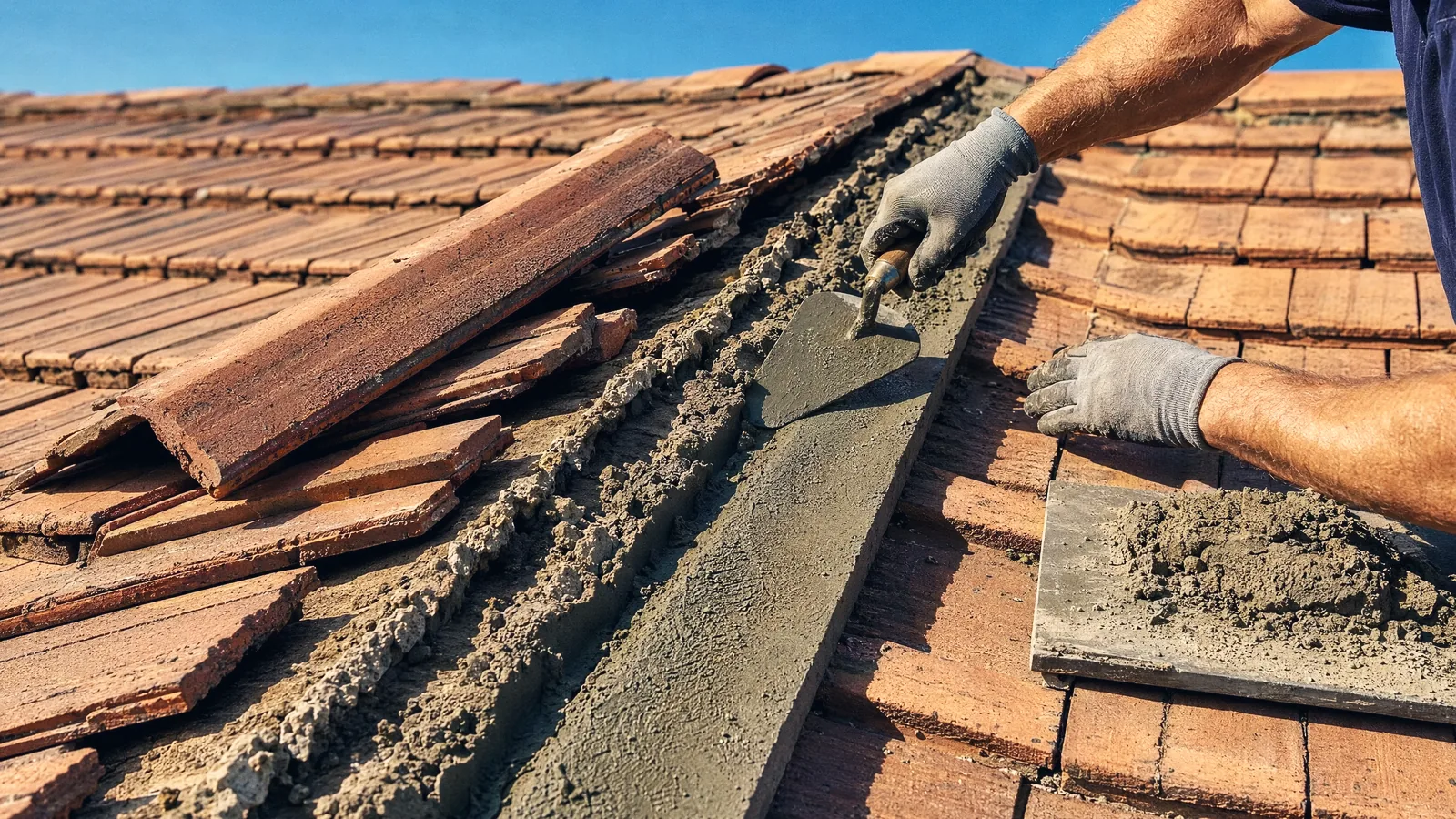
The ridge caps are the tiles running along the top of the roof and down the hips. They are not clipped on. They sit on a bed of mortar, and that bed is what holds them in position.
The bedding is that mortar bed underneath the cap. Re-bedding means lifting the caps off, removing the old mortar, and rebuilding the bed before setting the caps back down.
The pointing is the compound applied over the top of the bed, in the visible joint between the cap and the tiles either side. Re-pointing means renewing that surface layer only. The caps stay where they are.
So one is structural and one is a seal. Re-bedding costs substantially more because it is substantially more work, and a quote that does not say which it is has not told you what you are buying.
One is structural and one is a seal. A quote that does not say which has not told you what you are buying.
How to tell which yours needs
The test is whether the bed underneath has failed, and you cannot see that from the ground. What you can look for from the ground is the symptom that suggests it.
If the pointing has hairline cracks but the caps are all sitting straight and firm, you are probably looking at a re-point. The seal has aged and the bed has held.
If any cap is loose, sitting at a slightly different angle to its neighbours, or the cracking is wide enough to see from the ground, the bed is likely gone. Mortar breaks down once water gets into it, and once that starts the cap has nothing solid under it.
On a roof over about fifty years old, bedded in rigid cement mortar and never touched, re-bedding is the more likely answer. That is most of the post-war housing across Charlestown, Cardiff and New Lambton.
Why pointing over a failed bed does not work
This is the expensive mistake, and it is common because it is cheap and it looks finished. New pointing over a broken bed gives you a roof that looks correctly repaired and has nothing holding the caps down.
It cracks again, usually within a couple of summers, because the bed underneath is still moving. And the second time it cracks you have paid for pointing twice and still need the re-bed you needed at the start.
There is a related version of the same mistake, which is rigid cement mortar used for the pointing instead of a flexible compound. A roof expands and contracts with heat and rigid mortar cannot follow it, so it cracks on principle. If your pointing has failed once already, that is worth asking about.
New pointing over a broken bed gives you a roof that looks correctly repaired and has nothing holding the caps down.
What to ask a quote
Three questions, and if two quotes for the same ridge capping work are far apart, the gap is almost certainly hiding in one of them.
- Is this re-pointing, or re-bedding and re-pointing? The quote should say, in those words.
- What condition is the bedding in, and how did you establish that? The only way to know is to have lifted a cap.
- What is the pointing compound? Flexible is the answer you want. Cement is the answer that explains why you will be having this conversation again in three years.